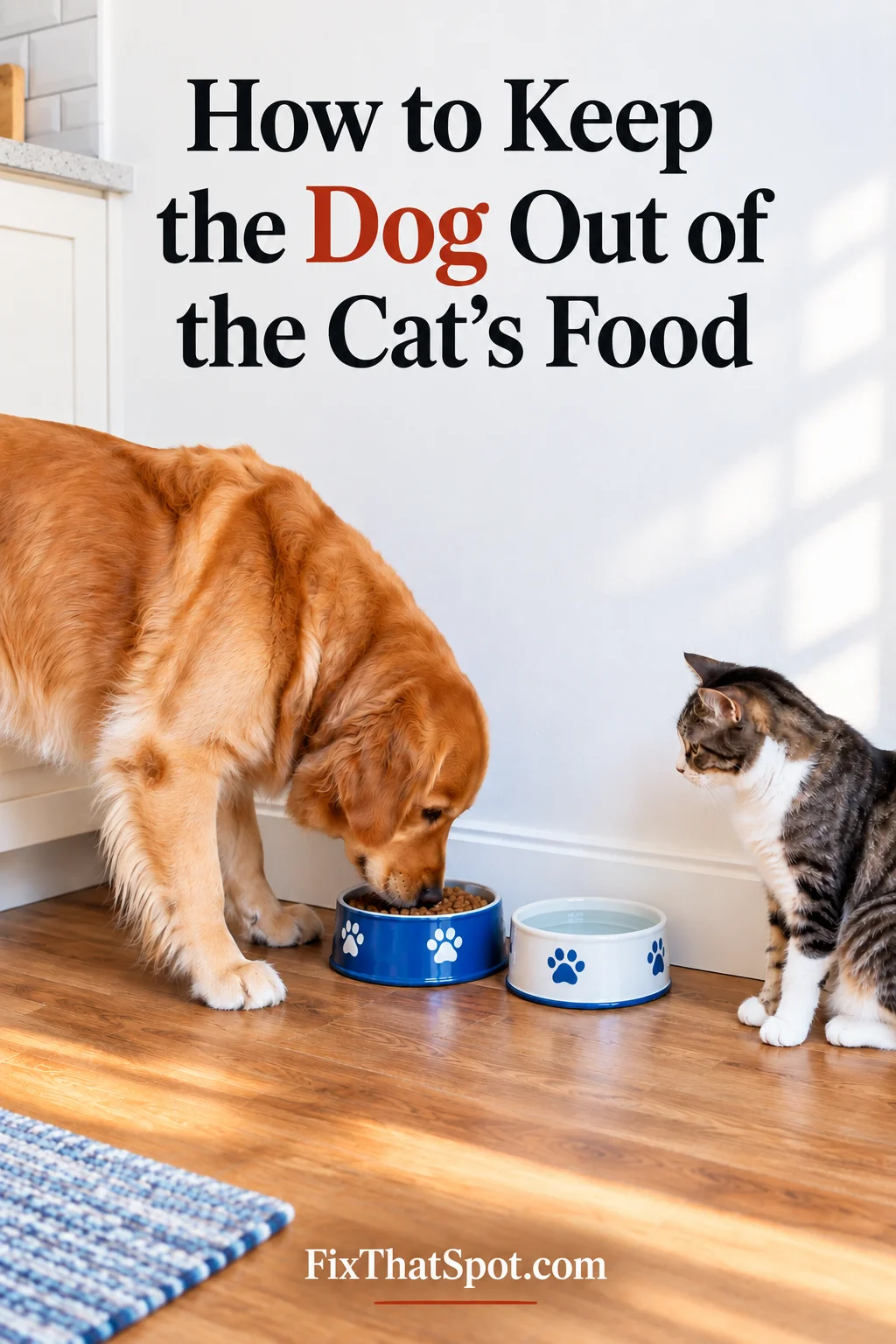
Putting down the cat’s food can become an invitation the dog was never meant to receive. The cat wanders away from the bowl, the dog notices, and the leftovers disappear.
Moving the bowl higher is an obvious fix. It can also turn a dresser, kitchen counter, or other piece of furniture into the cat’s permanent dining area.
The more useful distinction is not simply how high the bowl sits, but who can reach the space around it.
The dog does not need access to the same space just because the cat does. A dog-proof cat feeding station uses that difference. The bowls stay in a feeding area the cat can enter, rather than sitting where the dog can walk straight up to them.
Give the Cat a Route the Dog Cannot Use
The feeding station uses two levels. The bowls sit in the upper section, while a scratching-board section at the side provides a route up for the cat. A grille-style opening restricts access to the feeding area.
That arrangement matters more than simply raising the bowls. A determined dog may still investigate anything that smells like food. The useful part is that the dog cannot walk straight up to the bowls in the same way it could with a dish sitting on the floor.
There is an important limit here. The opening has to restrict your dog while remaining comfortable for your cat to use. A physical barrier is not automatically dog-proof for every combination of animals.
Check the Space Around the Feeding Station
This is furniture, not a small feeding accessory. At roughly 31.5 inches wide, 13.8 inches deep, and 36.2 inches high, it needs a permanent place in the room.
Depth is especially worth checking. The station may fit neatly against a wall but still project into a narrow walkway or the route through a kitchen or utility room.
The cat also needs clear access to the side used for climbing. Wedging the station tightly between other furniture can defeat part of the reason for choosing this design.
The lower cabinets give you somewhere to keep food and other cat supplies. More importantly, the bowls are no longer sitting out where the dog can reach them just by walking over.
A dog-proof cat feeding station makes the most sense when that physical separation works for both animals: the cat can comfortably reach its food, and the dog cannot follow the same route.
That is a more useful fix than spending every meal watching for the moment the cat walks away.