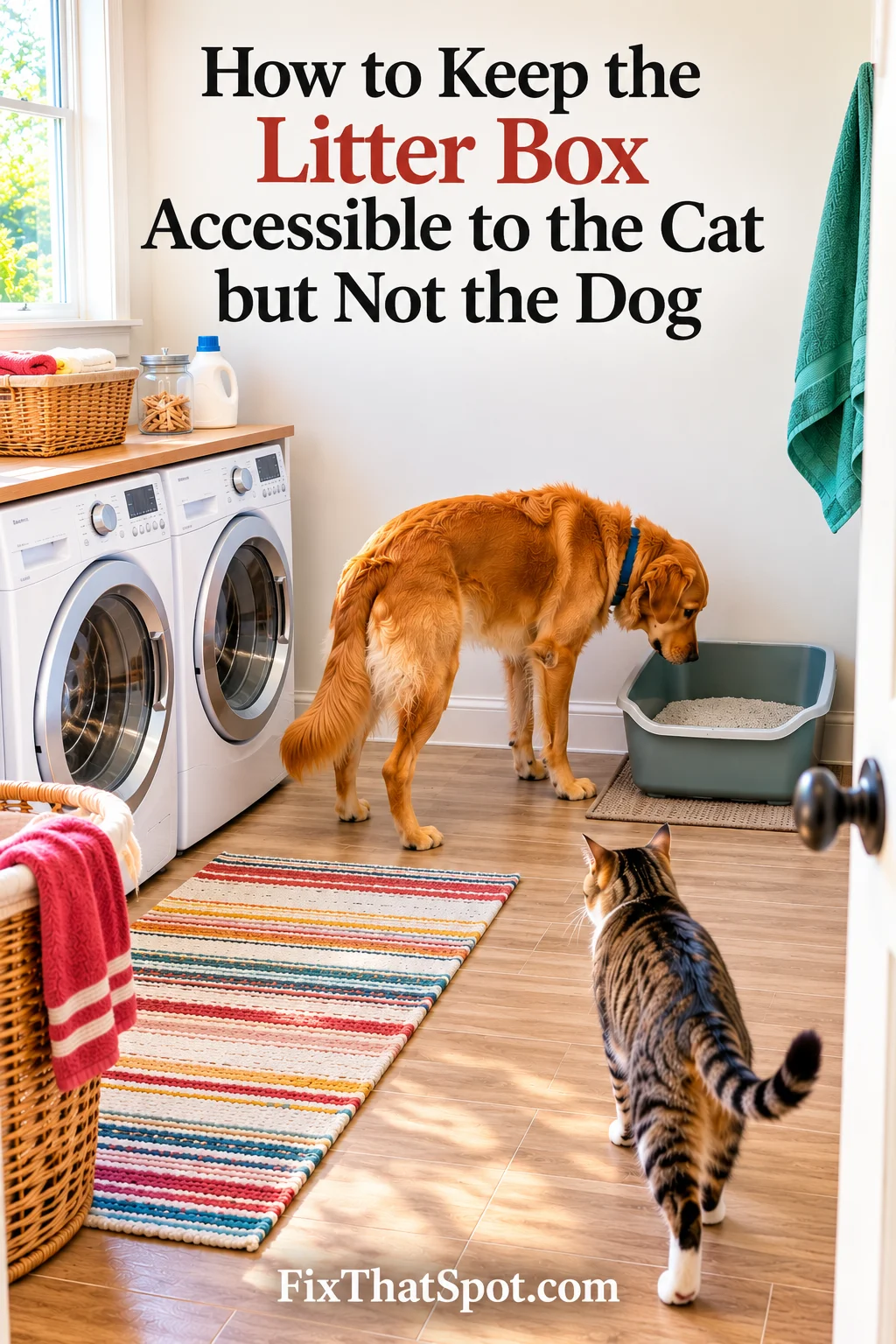
A cat needs to reach the litter box whenever it wants. Unfortunately, some dogs would also like unrestricted access, for entirely different reasons.
Moving the litter box can work if there is a room the cat can enter and the dog cannot. In many homes, there is no convenient spare room for that. Put the box behind a closed door and you have also locked out the animal that needs it.
The problem is not really where the litter box sits. It is the route into it.
A standard open litter box gives a dog the same easy approach as the cat. A basic covered box hides more of the litter, but a large front opening can still leave the contents within reach of a determined nose.
That is why simply adding a lid may not solve the problem.
A dog-resistant enclosed litter box can change the route instead. The useful designs do more than put a cover over the tray. They restrict the opening or use an entry-and-exit arrangement that makes direct access more difficult for the dog while leaving a usable route for the cat.
That distinction matters more than whether the box happens to have a hood.
The Cat Still Has to Be Able to Use It
Making the litter harder for the dog to reach only works if the cat accepts the new arrangement.
A box with a front entrance and top exit, for example, asks more of the cat than stepping into an open tray. The cat has to enter the enclosure and then climb or jump out through the top. That may work perfectly well for one cat and be a poor match for another.
This is where the word “dog-proof” needs some caution too. Dog size and persistence vary enormously. A restricted entrance that stops one dog may not stop another.
Look at the physical difference between the two animals rather than the label on the box. The useful question is whether the cat has a practical route that the dog cannot easily follow or reach through.
A latch can also matter on an enclosed design. If the dog can push or nose part of the enclosure open, the restricted entrance stops being much of a restriction. A secured enclosure keeps the intended route as the only route into the litter area.
The result should be fairly uneventful: the cat goes in, uses the box and gets back out. The dog reaches the outside rather than the litter.
Sometimes the Better Barrier Is the Room
Not every cat needs a different litter box. If the current box works well for the cat, changing access to the room may make more sense.
A doorway barrier can create the same basic arrangement on a larger scale: the cat can pass while the dog cannot. That can be particularly useful when the litter box already sits in a bathroom, laundry room, or another suitable space.
The important part is preserving the cat’s route. Simply keeping the door closed solves the dog problem by creating a cat problem.
There are ways of keeping dogs out of one room without closing the door, so it is worth considering the doorway before replacing a litter box the cat already uses comfortably.
If room-level separation is not practical, then the box itself has to do the separating. A covered litter box with controlled access keeps that boundary in one place instead of rearranging the room around the dog.
The goal is not to make the litter box difficult to reach. It is to make the dog’s route difficult while keeping the cat’s route easy.