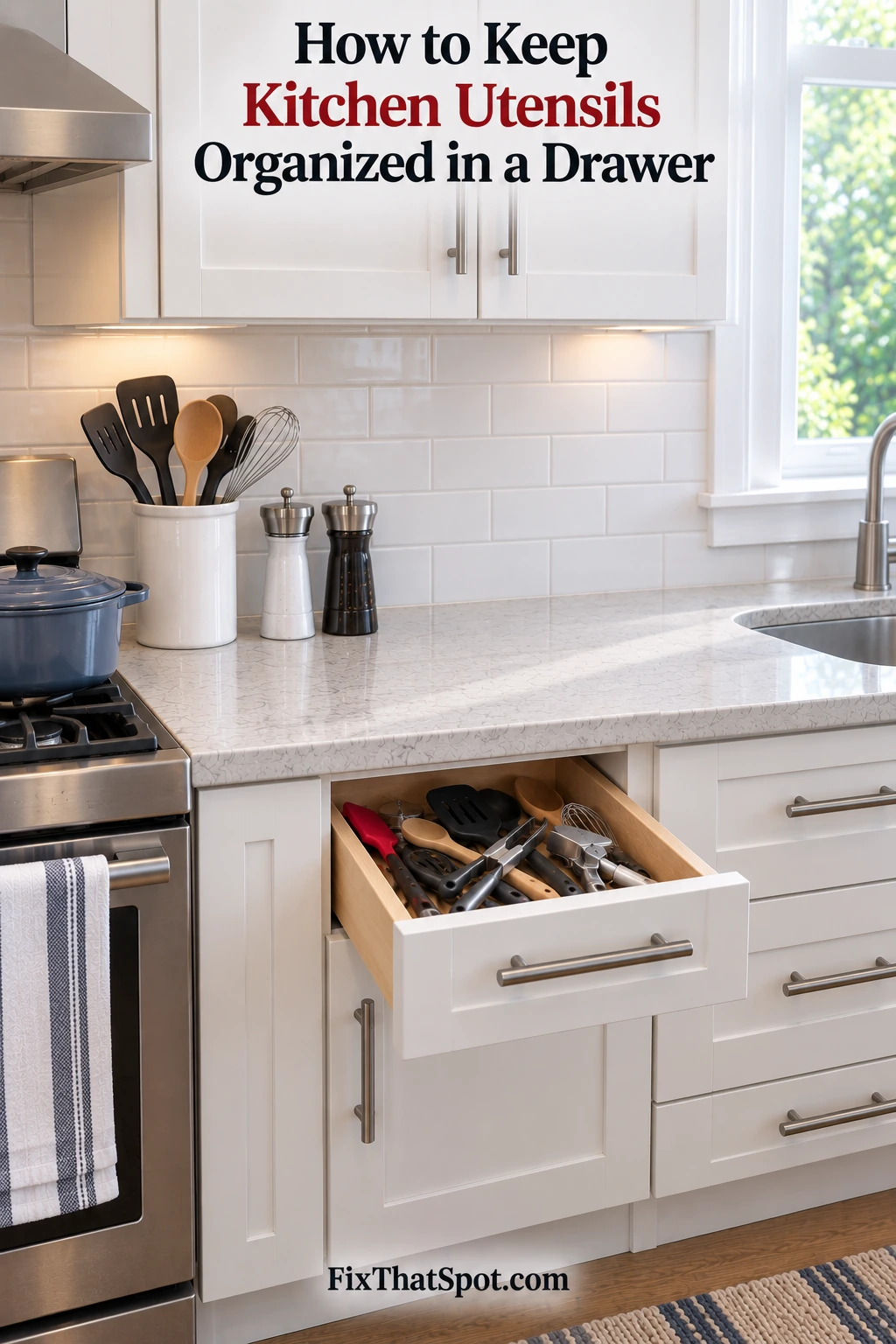
Open the utensil drawer quickly and the problem often shows up before you can grab anything. The tongs have opened across the drawer, the whisk is caught underneath them, and a spatula handle is blocking something at the back.
Sorting everything again will make the drawer look better. Once the tools are back in regular use, though, the same few pieces start wandering around.
A regular silverware tray can make this worse. Its narrow slots suit forks and spoons, but a whisk, ladle, or pair of tongs can take up the width of several slots before it even has room to lie flat.
An expandable organizer for long kitchen tools gives the bigger utensils wider places to land. Its dividers can be moved around the tools instead of squeezing a whisk, ladle, and pair of tongs into spaces designed more like silverware slots.
Long Utensils Need More Than Narrow Slots
A ladle and a vegetable peeler may be similar in length, but they take up very different amounts of space. Tongs are worse. Squeeze them into a narrow section and they tend to push against whatever is beside them.
Wider sections leave room for several similar tools to lie flat together. The dividers then have a simpler job: keeping the whisk out of the spatulas, for example, rather than giving every utensil its own little compartment.
That matters after the drawer has been used for a few days. You can drop a tool back into the right section without arranging the whole drawer again.
The organizer itself also needs to stay put. A tray that slides toward the front of the drawer every time it opens soon leaves an empty strip behind it. The non-slip base on this one helps with that movement.
Buyer feedback is not spotless. Some owners say the adjustable dividers can work loose, and particularly long tools may still be a poor fit. Those are useful limits for a drawer full of oversized utensils.
Check the Drawer Before Emptying It
At about 16.5 inches front to back, this is not a small organizer. Measure the usable space inside the drawer, including the width available when it is closed. A roomy-looking drawer is not much use if the organizer catches before the drawer reaches the cabinet.
There is also no need to fill every possible section. Leaving a little breathing room around bulky tools makes the drawer easier to use than packing each compartment until the handles overlap again.
A smaller drawer can develop the same sort of daily shuffle. If bedside items are the problem instead, there is a separate approach for a messy nightstand drawer.