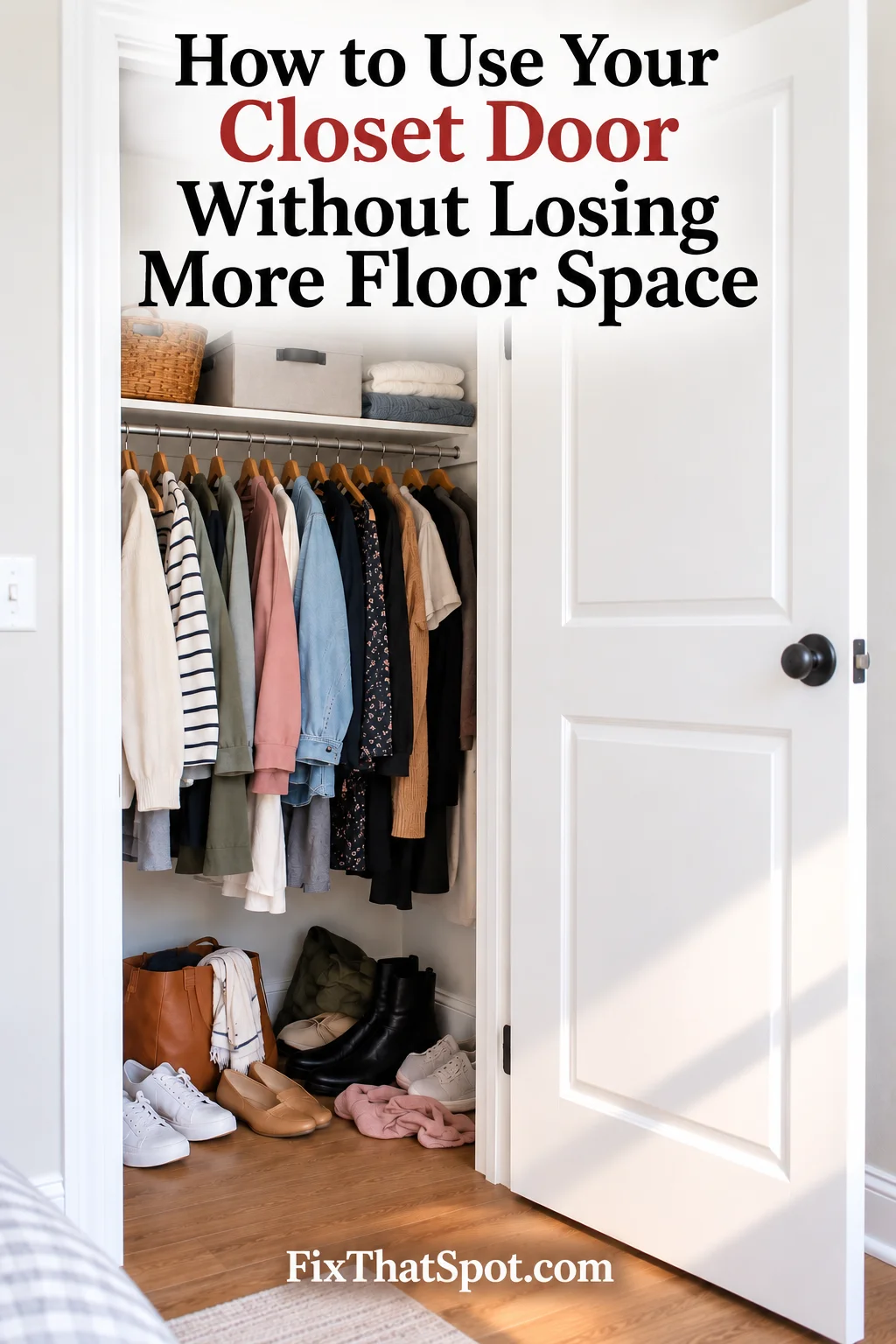
Closet floors have a habit of becoming the place where everything goes when there is nowhere obvious to put it.
Shoes line up under the hanging clothes. A bag gets pushed into the corner. Smaller things end up in boxes that have to be moved whenever you need whatever is behind them.
Meanwhile, the back of the closet door may be doing nothing.
An over the door organizer uses that vertical space without adding another shelf, cabinet, or storage unit to an already crowded floor.
Move the Smaller Clutter Upward
Some things naturally belong on a closet floor. Shoes are the obvious example.
The problem starts when socks, scarves, toiletries, folded clothes and miscellaneous smaller items join them. Putting everything into boxes may look tidier, but the boxes still occupy the same limited floor space.
This five-tier over-door organizer has five main pockets, each approximately 14.5 inches wide, 6.5 inches deep and 6.5 inches high. Ten smaller mesh pockets run along the sides.
That gives larger and smaller items different places to go. Folded clothes, small towels or toiletries can use the main pockets, while accessories and other little things can stay visible in the side pockets.
Clear windows on the main pockets help too. A deep pocket becomes less useful when you have to rummage through it to remember what is inside.
The Pockets Need to Hold Their Shape
Hanging organizers can become awkward when loaded. Soft pockets sag forward, making the openings harder to use.
This one has reinforced cardboard in the front, sides and bottom to help the pockets retain their shape. The manufacturer gives it a total capacity of up to 20 kg, or about 44 pounds.
That does not mean every closet door should be loaded with 44 pounds. The door, hinges and hooks still have to support whatever you put there.
For ordinary closet use, the useful feature is simply that the pockets have some structure rather than hanging like loose fabric bags.
Check the Door Clearance
Over-door storage only works if the door can still do its normal job.
The supplied hooks are designed for doors under 2 inches thick. Check that the hooks do not interfere with the frame when the door closes.
You also need room behind the door for the filled pockets. If the door normally opens against a wall, shelving or hanging clothes, the organizer’s depth can become an issue.
Using unused space is only an improvement if it does not make the door annoying to use.
What Should Go on the Door?
The best candidates are smaller things you use regularly but do not want scattered across the floor.
That might mean scarves, spare toiletries, socks, lightweight clothing or small accessories. There is no need to fill every compartment. Leaving some room makes it easier to see and retrieve what is there.
Handbags are different. Stuffing several purses into deep pockets can turn them into another pile, complete with tangled straps. If bags are occupying much of your closet floor, organizing purses separately can clear that space while leaving the door organizer for smaller items.
Use the Space That Was Doing Nothing
A small closet does not necessarily need another storage unit.
Moving smaller items onto the door can leave the floor available for shoes, bags or other things that genuinely need to be there.
The same idea works elsewhere in a small room. An awkward empty corner can sometimes provide useful storage without adding a wide piece of furniture.
The point is not to turn every empty surface into storage. It is to use overlooked space when doing so makes the space you already have easier to use.