
How to Get Living Room Privacy Without Blocking Natural Light
*This post may contain affiliate links. If you buy through these links, I may earn a small commission at no extra cost to you.*
*This post may contain affiliate links for which I earn commissions.*
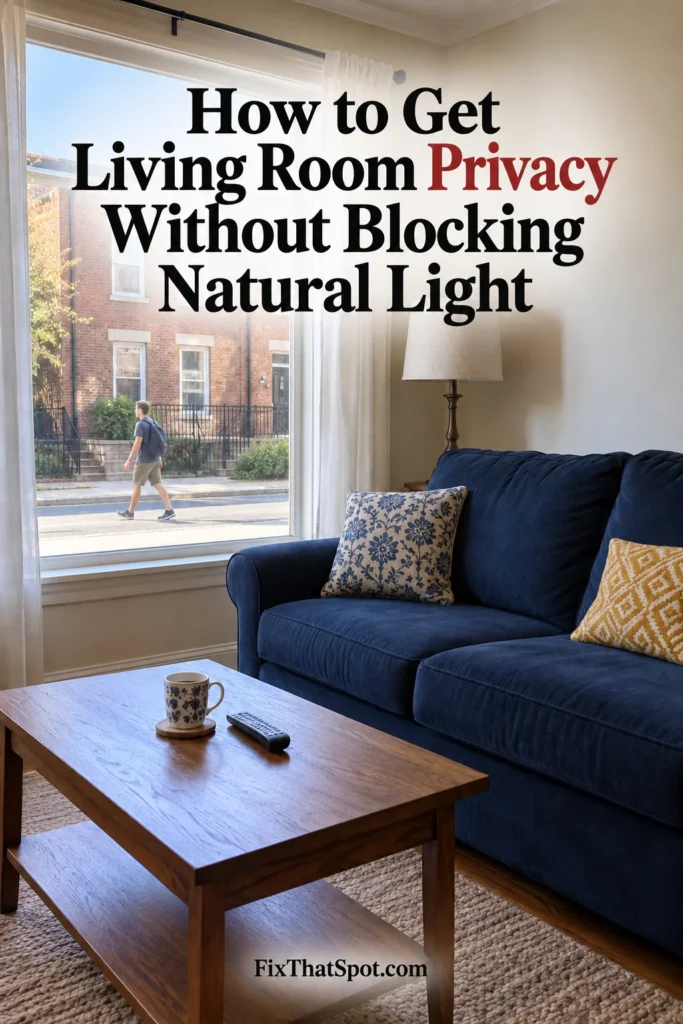
Closing the curtains at two in the afternoon works a little too well. Nobody walking past can see into the living room, but very little daylight gets in either.
The lamps go on, even though there is a perfectly good window behind several feet of closed fabric.
Leaving the curtains open is not much better when the window faces a sidewalk, neighboring house, or shared entrance. Anyone passing at the right angle can see the sofa, the coffee table, and whoever happens to be sitting there.
The obvious answer is to cover the window. The less obvious problem is that most of the window does not need covering.
People outside usually see into the room through the lower part of the window. The upper section may show little more than the ceiling. Hiding that part achieves very little, apart from making the room darker with impressive efficiency.
That is where a cordless top-down/bottom-up cellular shade changes the arrangement. Its upper rail can move down while the bottom of the shade stays against the sill. The fabric covers the direct sightline into the room while the top of the window remains uncovered.
A standard roller or cellular shade moves the other way. Raise it halfway and the bottom of the window is exposed first. That may bring in more light, but it also restores the exact view you were trying to block.
The deciding feature is therefore not “adjustable height.” Plenty of ordinary shades stop halfway. What matters is being able to uncover the window from the top.
The selected shade uses blackout fabric. Across the lower window, that gives more definite privacy than a sheer or loosely woven material. It does not have to darken the whole room because daylight still enters through the uncovered section above.
Lower the upper rail until the fabric blocks the view from outside. From the sofa, most of the window still looks open because the shade covers only the lower part.
After dark, that arrangement may need to change. Interior lights make rooms easier to see from outside, and the uncovered top of the window may still reveal part of the room from an elevated position. The shade can then close across the full window.
Check Whether It Will Fit
This model can be mounted inside or outside the window frame. An inside mount needs at least two inches of recess depth, and the shade should be 0.25 to 0.5 inches narrower than the narrowest measurement inside the frame.
Take one width measurement near the top of the frame, another across the middle, and a third near the sill. Order for the smallest of the three. A wider shade may rub against the frame or stick as you move it. If the recess is less than two inches deep, mount the shade outside the frame.
Privacy film can also obscure the lower part of the window while admitting light. Frosted film works well when that section never needs to be clear. Reflective one-way film is less dependable after dark because it relies on the outside being brighter than the room. Film also leaves the same part of the window obscured every day.
A top-down/bottom-up shade keeps part of the window uncovered. During the day, the lower section blocks the view from outside while daylight still comes through above it.