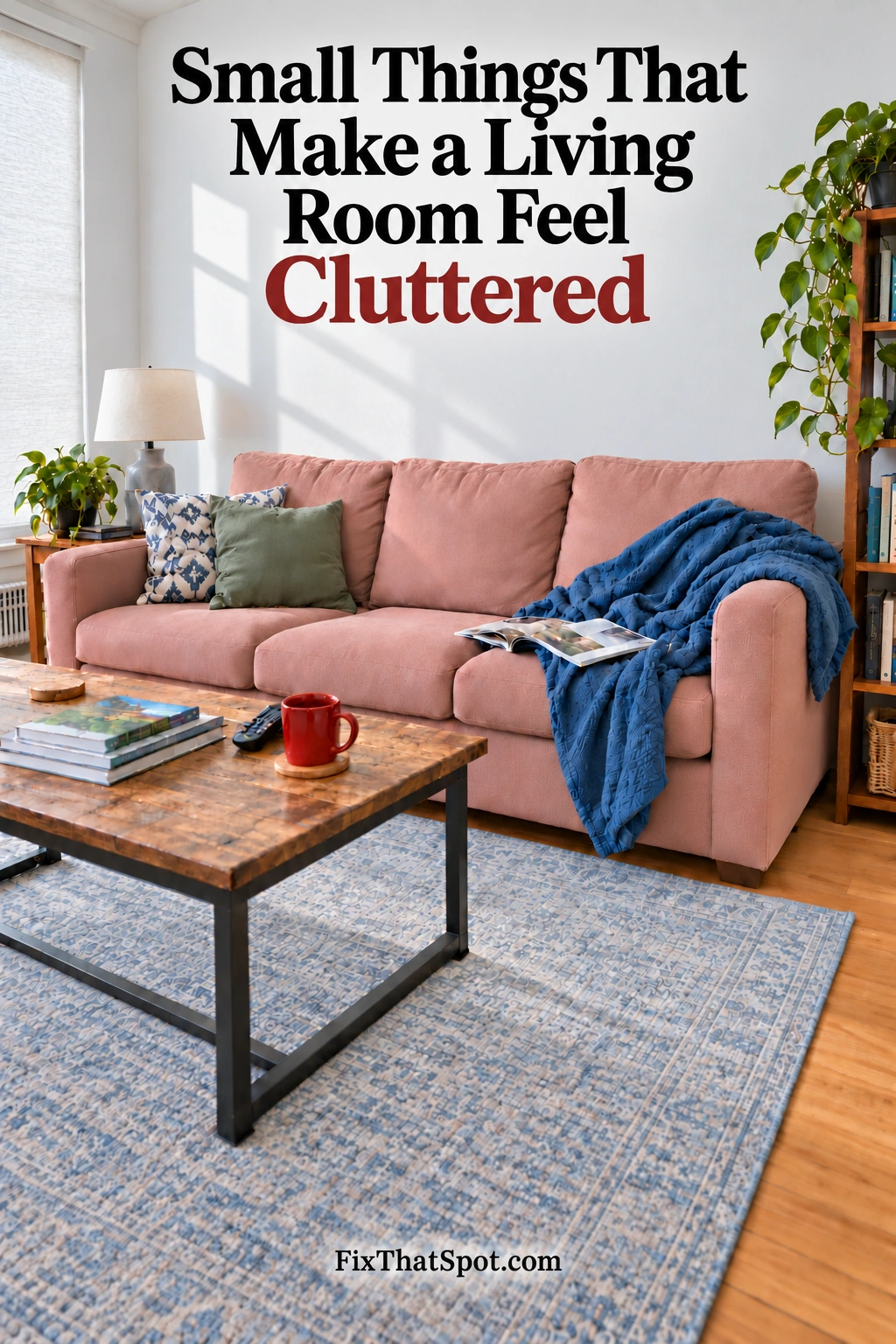
A blanket and an open magazine can leave little room to sit on the couch. Someone wanting to sit there moves them onto the coffee table, on top of whatever is already there. The room has been tidied, but there is now less space to set down a drink.
Clearing the couch shifts the pile to the coffee table. Now the seats are free, although setting down a drink means moving something else.
Some living-room clutter comes from this repeated shuffling. Before adding storage, it helps to look at where things are being left and what happens when someone needs that space.
The blanket needs to stay nearby, and the drink needs somewhere within reach. Finding space for them means looking at how the room is used, rather than moving everything out of sight.
The Blanket Moves From Seat to Seat
A blanket draped over the couch can stay there without causing much trouble. Two or three folded on a cushion take away somewhere to sit. They get moved onto an armrest, where the top one slides off as soon as someone brushes past.
A storage ottoman for blankets and everyday clutter gives the unused blankets somewhere nearby. If the room already has a footrest, replacing it with one that opens avoids adding another piece of furniture.
Books or a tray on top can make the ottoman awkward to use. Every time a blanket goes in or comes out, whatever is on the lid has to move too. That is worth considering if it will also serve as the coffee table.
There also needs to be room to open it. An ottoman squeezed beneath a table may hold plenty, but pulling it out every evening adds another reason to leave things where they are.
The Drink Is Just Beyond Reach
From the couch, picking up a mug on the coffee table means leaning forward, then settling back against the cushions. After doing that a few times, someone sets it on the armrest beside them, where a passing elbow can knock it off.
Moving the coffee table closer helps until someone needs to walk past. In a narrow room, that gap may be the route to the other seats.
Finding somewhere to put a drink beside the couch can solve the reach problem without closing that route. A small table beside the arm may be enough. Where there is little space alongside the couch, a table with a base that slides underneath can bring the top closer.
That base needs to fit beneath the furniture, though. Low couch frames can prevent it from sliding far enough in, leaving the table sticking out where someone walks. The useful measurement is the clearance under the couch, along with the space beside the seat.
The Remote Disappears Without Leaving the Couch
Searching for the remote often begins with the blanket. Then the cushions come up, followed by a hand down the side of the seat. It was nearby when the television went on; a few changes of position were enough to hide it.
An organizer can keep it separate from the cushions, but an empty pocket across the room does little for someone already sitting down. The remote is likely to stay beside them.
For keeping the remote from slipping between couch cushions, a holder needs to sit within easy reach and stay there when used. On a rounded or slippery armrest, an organizer may shift when the remote is pulled out.
A shallow pocket can also be easier to use than a deep one that hides the whole remote. Being able to see and grab it from the seat matters more than having enough compartments for every small object in the room.
Things Keep Disappearing Under the Couch
Things end up under the couch. Sometimes they stay there for a while. Sometimes they don’t. It depends on when someone notices or decides to deal with it. Often, the space underneath just becomes another place where things sit unnoticed.
That’s where an under-couch blocker can help. It closes off the gap so small things stay out in the open instead of rolling out of sight. Some versions are clear enough that they hardly stand out, while others work better with taller furniture.
Most people don’t think much about the space under the couch. Then something slides underneath again. Putting in a simple barrier that keeps things from disappearing under the couch means one less place in the room that quietly collects things.
The TV Cord Still Hangs in Plain Sight
Mounting the TV clears the top of the cabinet, but the power cord may hang down the wall to the outlet. Pushing furniture in front of it hides the lower part while leaving the rest visible beneath the screen.
A cover for the visible cord beneath a wall-mounted TV contains that exposed stretch. Its route needs to follow where the cord actually goes, including any turn toward the outlet.
Matching the cover to the wall makes it less noticeable. The cord remains accessible, but no longer hangs loose between the screen and the furniture.
The Litter Box Is Always in View
In some homes, the living room is the only practical place for the litter box. Moving it farther into a corner keeps it out of the walkway, but it remains visible from the couch.
Furniture designed for hiding a litter box in the living room can put it behind cabinet doors while leaving an entrance for the cat. The cabinet needs enough space for the litter box itself, with room to remove it for cleaning.
That access is easy to overlook when choosing something that looks like a side table. If the box only comes out at an angle, emptying it becomes awkward. The furniture should conceal the box without making its daily care harder.
Less to Move Before Sitting Down
Moving a blanket into the bedroom clears the couch, but someone has to bring it back for the evening. The same goes for a remote put away in a drawer across the room.
Those things need places close to where they are used. Once they have them, clearing a seat no longer means covering the coffee table instead.